
Training Fundamentals
Fundamentals of Dog Behavior
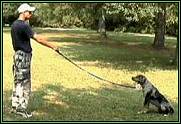 You must learn the fundamentals of dog behavior to be effective at training your dog. Understanding why
dogs do what they do, will help you control the problems that are occurring, help ease the lessons you are teaching, and assist you and your dog in reaching a mutual respect.
You must learn the fundamentals of dog behavior to be effective at training your dog. Understanding why
dogs do what they do, will help you control the problems that are occurring, help ease the lessons you are teaching, and assist you and your dog in reaching a mutual respect.
Timing
Timing is an important part of any training. Your reaction to a specific behavior must be made in a timely manner, or the dog will be confused by the correction. If you cannot make a correction within three seconds of the command or incident, you have lost the opportunity to make a correction. For example - you see your dog turning over your garbage can. You yell at him but he continues to nose around in the garbage. You look around for something to throw in his direction. When you finally have something, he is out of the garbage and chewing on his bone. Out of frustration, you throw the object and yell at the dog. The lesson that is learned here is that you don't want him chewing on his bone. This is not the lesson you wanted to teach, but it is what the dog learned. Improper timing will compound the problem or create another one. If you were prepared for the situation, you would have done a better job of correcting it, and your dog would have understood the correction. Seeing your dog do something unacceptable is just an indicatiojn that you must be prepared to correct that behavior the next time it occurs. Even if it means setting him up in order for you to catch him in the act. Then, you must be ready to apply a correction "On Time" in order to have respond positively. Praise and/or correction must be applied within three to five seconds in order to have the dog associate it with his actions. The timing of Praise, is just as important as corrections. The three second rule applies here as well.
Patience
Since the dog does not understand our language, he has to be taught the command and action desired. Only then will he be able to associate the desired response with the command. You cannot expect to talk to the dog and have him understand what you want withou first teaching him. He is not going to learn a command and associated response on the first attempt. You will have to repeat the lesson until he understands the proper response that is associated with the command word you provide. During training, he may become distracted by things he considers more important. He is curious about everything, especially the things that have an odor. You want him to pay attention, but he wants to sniff the ground. Sniffing is a part of his existence, and it informs him of all that is going on around him. You must be patient and work around or throuogh the problem in order to correct it. Allowing your frustrations or anger to prevail will not make him pay any more attention, or respond any better. They will only serve to have him want to be away from you during training, so be patient with him. He wants to please you, but he has not yet learned your wishes. Dogs are not logical thinkers, and they do not start out their day looking for ways to upset you or get even with you. They are just being dogs and doing what comes naturally for them. If you have had a bad day, or if you are not feeling well, it is best not to train the dog on that day. You must remain patient with your dog while training or you will suffer more setbacks than progress.
Motivation
Motivation can be either positive or negative. Positive Motivation (praise) will have your dog performing the tasks that you request of him. Negative Motivation (correction) will
stop the undesired behavior. With some of the newer training systems, positive motivation includes giving a food reward for obedience. I don't like having to carry treats in my pocket
to reward the dog. It is unnecessary, especially when the thing they want most is hanging at the end of your arm. HANDS!
When your dog receives praise, soothing tones, and is patted with your hand, he is motivated to continue the behavior he has just displayed. Any time you place your hands on your dog,
he believes that you accept his action. However, when he receives a correction or Negative Motivation, he understands that the behavior was undesired. Corrections will curtail
undesired behaviors. As your dog receives the signals or commands to perform, he associates the word or sign with a pleasurable experience, Positive Motivation, and he will perform.
Knowing the difference between Praise (Positive) and Correction (Negative) aids in his learning the proper behavior, and he will do so in order to receive praise rather than undergo a
correction for improper behavior. These motivators are the operative actions of a pack, and one the dog readily understands.
In the whelping pen, the dam does not dole out treats when she is teaching her puppies what is acceptable. When an action is unacceptable, she will lash out in the flick of an eye and
nip the puppy on the side of the neck. The puppy will run away squealing, but, when examined there there are no marks on the puppy. This was an effective correction, and the puppy
will not make that mistake again. When a puppy is responding well, the dam will lick the puppy to show approval. We don't lick our dogs, but we certainly do touch, pet, and praise
them...."Oh, what a good boy you are"....and all for no reason or performance. Before petting your dog, have him perform an action, such as sitting. He will be more attentive to your
wishes when he understands he has to earn those hands.
Consistency
Whatever method you choose to train your dog, you must be consistent with that method. Changing methods from day to day will only confuse the dog. Giving a command for an action and then altering the word or phrase may confuse him. Consistency provides the repetitious action that a dog requires in order for him to learn. Choose a method that is comfortable for you, and begin training the dog. Give the method some time to work. Do not expect to find a miracle method that teaches the dog without any involvement or effort on your part. If that method does not appear to be working for you after you have given it a reasonable amount of time, then change the method, but stick with the change. Do not continually alternate between the two and expect the dog to learn. He has to process what it is you desire, and the only way he will be able to do that is if you are consistent with your training method and commands. Most owners simply want a dog that will obey their commands, but have the misconception that Obedience Lessons ares meant for those who perform in Competition Events. Obedience Lessons are designed to help you train your dog to display good manners. Instructions are aimed at teaching the owner how to teach their dog to respond to their wishes. This training puts the owner and the dog on a level field of learning, while the trainer simply guides the owner through the methods. He is the mediator between you and your dog. He keeps you on track and helps to calm your frustrations when you are having a problem communicating with your dog. In all the years that I have been teaching, the one thing I hear from owners after graduation is this: "I will never own another dog that has not been obedience trained." Training your dog to have manners is no different from training your child to be polite. Your well-mannered, attentive dog becomes more acceptable to you and to those around you, and your dog respects you for being a leader.
Continue to Training Commitment